The other day, the girls and I were doing a 1000-piece puzzle of the Muppets, and we had the The Muppet Show Season One DVD playing in the background to help set the Muppet mood.
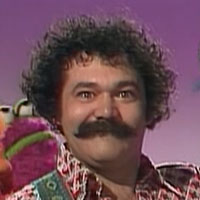
At one point, Emma looked up at the TV and asked, “Dad? Is that Jack Black?”
At the back of the catwalk on Bravo’s Project Runway, there’s a large, translucent panel with the Project Runway logo.
During the first season there were a number of times when they had a camera backstage watching the models enter or exit the catwalk, but since the entire logo wasn’t in the frame, this is all you’d see:
They’d spent hundreds of thousands of dollars on branding and marketing and yet, week after week, they seemed intent on leaving people with the subliminal impression that the show was a big YAWN.
I think they’ve learned their lesson, though. I’ve watched the first three episodes of the second season and I haven’t seen the big YAWN once.
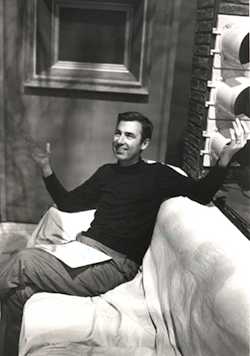
I honestly didn’t plan on saying anything about the recent passing of Mr. Rogers. I knew that there was going to be a great deal of ink (and/or pixels) devoted to the man, and I figured it was probably going to come in two waves. First would come the usual eulogies and respectful retrospectives. Then the dismissive “Grow up, people! He was just some white guy in a cardigan who lived in an overly-simplistic, artificial environment with creepy hand puppets…” contingent would follow.
But even I, cynic that I am, was taken aback by a third wave of invective that was hurled in Mr. Rogers’ general direction with such volume and force that I felt like I had to do something. I mean, it’s one thing to disparage a man’s life’s work just because it didn’t speak to you personally, but some folks have gotten downright nasty (literally). I feel like I should say something profound to counter this third wave of rubbish, but my cold medicine (I’ve got a wicked cold and sore throat today) has probably rendered me incoherent. (As if that’s ever stopped me in the past…)
I spent part of my childhood in Iceland, where there was only one English-language television station on the local U.S. Air Force base. It only broadcast for about four hours every day and it didn’t have any kid’s shows at all until the last year we lived there, when they added a full hour of Captain America and the Incredible Hulk cartoons on Saturday morning. We thought we were living in a media nirvana.
Living in this children’s programming wasteland meant that I came a little late to Mr. Rogers’ Neighborhood. By the time I started watching him, when I was 9 or 10, I was well out of the target demographic. While I used to love it when he would visit Chef Brockett to make a nutritious fruit salad, or when Picture Picture would show how loaves of bread were mass-produced, I wasn’t too sure about the Neighborhood of Make Believe.
I mean, I kind of understand the “creepy hand puppet” sentiment because Lady Elaine Fairchild used to scare me to death. I was pretty sure that if I lived in the Neighborhood of Make-Believe, she would have konked me on the head with her Boomerang Toomerang Zoomerang, dragged me behind her Museum-Go-Round, and beat the crap out of me on a daily basis unless I relinquished my lunch money. I, in turn, would have spent a great deal of time and energy restraining myself from slapping Henrietta Pussycat <meow, meow> upside the <meow, meow> head <meow>. (Do you see how the cycle of violence is perpetuated?)
But it never occurred to me to be dismissive just because I was far too sophisticated (at 9 years of age) to really appreciate the show. The fact that there was any kid’s programming at all was a wonder to me.
I did, however, fall into the trap a little later on in life. When I was a wee bloke, I loved Rogers and Hammerstein musicals. Every year, when “The Sound of Music” would come on (this was pre-VCR…post-talkies), I would sit there glued to the TV, fantasize about having Julie Andrews as a governess, and think about how brave I would be as we fled over the Alps ahead of the Nazi hordes. I was pretty sure I would look great in Lederhosen, too. (I’ve got the legs for Lederhosen.)
But, years later, as my tastes matured, I got to the point where the simplistic story lines and syrupy-sweet lyrics of a Rogers and Hammerstein Schmaltzfest just didn’t cut it anymore. I had discovered Stephen Sondheim and, because I was in the middle of that “more-sophisticated-than-thou” phase that we all go through in life, I thought his darker, edgier vision was much more attuned to my newly-cultured palette. During this period of my life, if someone would suggest that I go see a local production of “Oklahoma” that a friend was in, I would roll my eyes (literally), sigh the sigh of the terminally bored, and think to myself, “That’s baby stuff.”
[Tangent: Which reminds me of an episode of Arthur (one of the best shows on TV today) in which Mr. Rogers (voiced by Mr. Rogers) comes to stay with Arthur’s family for a few days, but Arthur doesn’t want anyone to know because all his friends think that Mr. Rogers Neighborhood is a “baby show.” Turns out that even though everybody tries to act cool and say that they’re “too old” for Mr. Rogers, they fall all over themselves when the actually meet the man.]
There’s a book (long out of print) entitled Playwrights, Lyricists, Composers, On Theater, that features transcripts from a series of forums that had been conducted by the Dramatists Guild Quarterly back in the late sixties. These forums were kind of like Career Day at school. People would get up in front of an audience and sort of riff on what they did for a living. But instead of hearing from an insurance broker or a civil servant, you got to hear from people like Edward Albee, Paddy Chayefsky, Arthur Miller, Walter Kerr, Arthur Laurents, and Stephen Sondheim.
The transcript from the forum featuring Stephen Sondheim (imaginatively entitled “Theater Lyrics”) begins with the following:
To start off with a little history: I first got into lyric writing because when I was a child of 11 my parents were divorced and we moved to Pennsylvania. I moved there with my mother, and among her friends were the Hammerstein family. They had a son my age and we became very close. Oscar Hammerstein gradually got me interested in the theater, and I suppose most of it happened one fateful or memorable afternoon. He had urged me to write a musical for my school (George School, a Friends school in Bucks County). With two classmates I wrote a musical called By George, a thinly disguised version of campus life with the teachers’ names changed by one vowel or consonant. I thought it was pretty terrific, so I asked Oscar to read it — and I was arrogant enough to say to him, “Will you read it as if it were just a musical that crossed your desk as a producer? Pretend you don’t know me.” He said “O.K.,” and I went home that night with visions of being the first 15-year-old to have a show on Broadway. I knew he was going to love it.
Oscar called me in the next day and said, “Now you really want me to treat this as if it were by somebody I don’t know?” and I said, “Yes, please,” and he said, “Well, in that case it’s the worst thing I ever read in my life.” He must have seen my lower lip tremble, and he followed up with, “I didn’t say it wasn’t talented, I said it was terrible, and if you want to know why it’s terrible I’ll tell you.” He started with the first stage direction and went all the way through the show for a whole afternoon, really treating it seriously. It was a seminar on the piece as though it was Long Day’s Journey Into Night. Detail by detail, he told me how to structure songs, how to build them with a beginning and a development and an ending, according to his principles. I found out many years later there are other ways to write songs, but he taught me, according to his principles, how to introduce character, what relates a song to character, etc., etc. It was four hours of the most packed information. I dare say, at the risk of hyperbole, that I learned in that afternoon more than most people learn about song writing in a lifetime.
I remember having to stop after I read that because my ears were popping due to extreme changes in intellectual altitude. In my mind, Stephen Sondheim and Oscar Hammerstein were polar opposites. I couldn’t even comprehend them being in the same room, but there was Stephen Sondheim explaining how Oscar Hammerstein provided him with what amounted to a six year course of study on how to write musical theater. Referring to his first real job on Broadway, he says:
…this was the first professional work I had done, and I was prepared to do professional work only because of what Oscar had made me go through.
I wasn’t quite sure what to do with this information. How could I reconcile my distaste for the “baby stuff” lyrics of Oscar Hammerstein with the high regard in which Stephen Sondheim obviously held his mentor and friend? The answer came a little further on when he was asked about his favorite lyricists:
I’ll tell you a little bit about what I like about them. The best thing about [Cole] Porter, the most astonishing thing to me is not his facility with words — facility with words is fairly common. He believed what he wrote, that’s what kills me. Oscar did too. Oscar was able to write about dreams and trees and grass and stars because he believed in them, and what Porter believed in was gossamer wings. No man on earth can write “gossamer wings” except Cole Porter, and nobody has been able to imitate Porter successfully because they don’t believe what he believed.
It’s that simple. What makes Oscar Hammerstein’s work worthwhile is not that I believe in the things he wrote about. It’s that he believed in them. Doesn’t the whole modern ideal of embracing diversity in people boil down to the ability to appreciate the gifts and beliefs of others, even though you may not possess those same gifts or hold those same beliefs.
If you really cherished diversity, how could you not cherish Mr. Rogers? There was absolutely no one like him. Heaven knows, he never followed fads, he never sold out, he never altered his presentation as a result of focus group research (“Could you talk a little faster? 78% of respondents said that they felt uncomfortable with your delivery. And we need to do something about Mr. McFeely. 67% felt that someone younger would provide more efficient parcel delivery and be less likely to hang around shooting the breeze instead of delivering their Vanity Fair in a timely manner. UPS guys in those brown shorts scored very well with the 17-35 female market segment.”) He was an honest, caring man who, “according to his principles” and in his own way, was doing good in the world for millions of small, adults-in-training every day. Heaven knows there are blessed few on this earth about which the same could be said.
So, whether I liked Mr. Rogers (or not) has absolutely nothing to do with it. It was never Fred Roger’s obligation to be true to me. He only needed to be true to himself — and he was. And that’s what made him great. And, as far as I’m concerned, the neighborhood is a little scarier place without him.
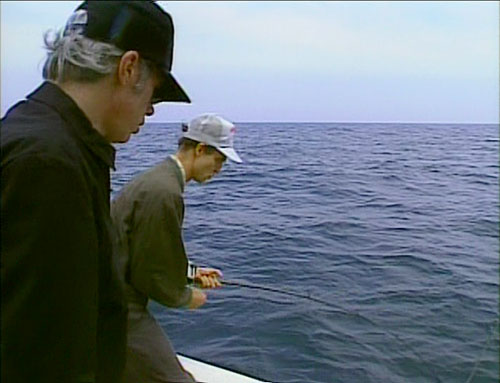
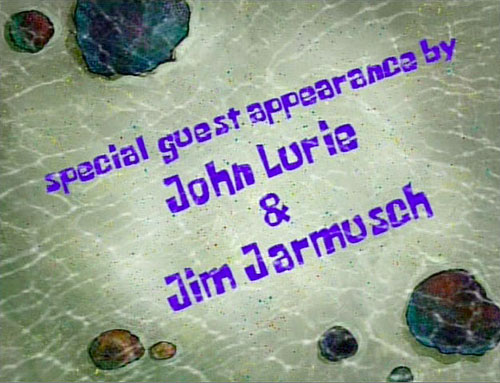
So, I was watching the latest SpongeBob DVD, Sea Stories, with my daughters and during an episode called “Hooky” there were a few live-action shots of some fishermen on a boat. I did a massive double-take and hit the pause button (much to the annoyance of the under-8 crowd).
That’s right, it’s Fishing With John. I hadn’t noticed the following during the opening credits:
KUED is the PBS affiliate in Salt Lake City, Utah. Like all good bleeding-heart moderates, I have been a contributor to KUED for quite some time. In the past, I have only been able to pledge the basic membership amount of $36/year. But this last year I was flush with cash and bonhomie when the pledge breaks rolled around so, in a fit of cultural elitism, I pledged $13/month, for a total of $156/year. This was an astounding amount for me, and it represented a significant sacrifice, but I thought that it was worth my support.
And then I realized that I had awakened a deadbeat uncle.
You know what I’m talking about. Most families have one. That deadbeat uncle who’s never been able to support himself. The one who’s always in need of some sort of financial fix. And if you give the deadbeat uncle money, you’re done for. Because no matter how much you give the deadbeat uncle, it’s never enough. In fact, it’s better not to give the deadbeat uncle anything, because once he smells cash he’ll never stop hounding you for more.
Well, in my previous incarnation as a $36/year peon, I was completely ignored by KUED. I was lucky to even get a members card. (Two years in a row I had to call them and have them send me one. Not that I’ve ever used it, but that’s another story…) But, when I bumped my contribution to $156/year, the deadbeat uncle woke up and smelled cash.
I was immediately placed on some “patsies” mailing list and began to be inundated with requests for additional funds. After being bombarded for over nine months, I had finally had enough…
The Letters
…so I sent the following e-mail message to KUED’s Member Services:
Folks,
I’ve been a regular contributor to KUED, though on a small scale, for quite some time. This past April, however, I bumped up my contribution to $13 per month. I’ll never make that mistake again.
You see, when I was a small-time contributor I would receive a yearly request to renew my membership…which I did. But I must have crossed some invisible line, because ever since I upped my contribution I have been bombarded by more and more requests for more and more money:
“Hey you, send us more money and we’ll let you into the Director’s circle!”
“Hey you, you gave us a lot of money once, why not do it again?!”
“Hey you, your membership doesn’t expire for another six months but we’ll send you this thing that looks like a renewal in case you aren’t keeping track and we can get two pledges from you in a 12 month period!”
I received yet another one today (I didn’t read it very carefully, but I think was “Hey you, it’s the end of the year, why don’t you send us more money!”), and I think I’ve had enough.
Next April, I’m going to disappear back into the $36 a year rabble. Maybe then you won’t spend my $13 a month trying to get me to send you more than my $13 a month.
A little tongue in cheek (but not a lot),
[Me]
…and received the following in response:
Dear [Me],
We appreciate all that you have done to contribute to the programming aired on KUED, Channel 7. Our mission to serve the community by providing quality programming is only made possible through the efforts of individuals such as yourselves.
I’m sorry that you feel like you’ve been bombarded with requests. Thank you for your time and effort to let us know how you feel. It’s always helpful to receive feedback from our viewers and members in order to serve you better.
Although you will be unable to contribute as much in the near future, we appreciate your efforts thus far. So thank you for your support of KUED and public broadcasting!
I have forwarded your e-mail to membership and they’ll take care of the records.
Thanks again. We hope you continue to find the programs on KUED worth your time to watch and worth your continued support.
Sincerely,
[A Nice Person In Viewer Services]
Viewer Services
I also followed up with a phone call and let them know that I no longer wished to receive any more solicitations of funds, that I would be happy to renew my membership next year at $36/year, but that I was no longer to be considered a source of increased revenue.
Well, only a week went by before I received yet another solicitation. This was another from KUED’s Directors Circle. The Directors Circle is reserved for KUED patrons donating $250/year or more. In addition to the basic membership privileges of the $36/year peons, the members of the Directors Circle get quite a few perks: a KUED production to add to your home video library, member appreciation events, insider newsletters, program updates, invitations to station events, etc.
And since this was the holiday season, it closed with the following:
At this special time of year, I urge you to send an additional gift of support without delay.
Sincerely,
Fred C. Esplin
General Manager
This letter really ticked me off for a couple of reasons:
It was yet another example of deadbeat uncle behavior. I’ve already pledged $156.00 a year, but that’s just not enough. They need more. And not only do they need more, they need it now, during the holiday season when cash is not something that I have in abundance. But, what do they care? My daughter can do without those shoes. That money would better be spent boosting me into the exclusive Directors Circle.
Let me get this straight. This is supposed to be PUBLIC television, but there are PRIVATE events going on all the time that I’m not invited to because I haven’t ponied up $250.00?
That last line was simply too much to bear.
So, I fired off a letter to Mr. Esplin outlining my previous correspondence and ending with:
HAVE YOU PEOPLE GONE TOTALLY INSANE!?!
You’ve either become completely addled by your relentless pursuit of cash or you are the perfect embodiment of evil. I can’t decide which. Are you merely ungrateful and insensitive or have the accountants taken over?
First, get therapy. Second, you might as well take my name off of your records because you can now kiss my $36 a year goodbye, too.
P.S. I especially liked the line: “At this special time of year, I urge you to send an additional gift of support without delay.” In other words: “Hey you! Forget the orphans and needy! Just send us more money!”
Well, I received a nice letter from Mr. Esplin who apologized vaguely for any offense, but then spent the bulk of the letter explaining the importance of sending more money to KUED.
“That’s fine,” I thought. “I’ve washed my hands of KUED. I’ll never hear from them again, and they’ll never hear from me.”
…but…
Then I heard from them again (“Don’t just send us money, send us gifts of stock!”), and again (“Hey you, you haven’t sent us money!”), and again (“Hey you, when you die, how about leaving us some money!”). And today I received yet another from the Directors Circle (“Hey you, you can’t be one of us unless you send us more money!”)
At last count, I’ve received eight letters in the last 2 1/2 months! No…really! Eight letters!
At what point does this become harassment? Can I sue yet? And what, exactly, does one have to do to get through to these crazed, greedy scumbags? STOP ASKING ME FOR MORE MONEY!
My original thought was that I’d walk into KUED’s business offices, strip naked, scrawl “EAT HOT DEATH YOU MONEY GRUBBING SWINE!” on my scrawny chest, and proceed to do the Dance-Of-Death-To-Money-Grubbing-Swine on the startled receptionist’s desk.
However, I decided that this would frighten the receptionist, get myself arrested, and probably only confuse Mr. Esplin who would be busy trying to figure out whether the Dance-Of-Death-To-Money-Grubbing-Swine should be added to the list of perks for members of the Directors Circle. Perhaps I would be invited back for an encore performance during one of their “station events.”
So, I concluded that a phone call would be more appropriate.
The Phone Call
So, I called Anne Ibach, the director of Member Services, who received a thorough tongue-lashing. Well, at least her voice mail did.
A few hours later, and a few degrees cooler, I finally got the real, live Ms. Ibach. I expressed my anger and frustration (I didn’t bring up the Dance-Of-Death-To-Money-Grubbing-Swine) and was told that I had gone about things the wrong way.
You see, if you say that you want to have your name removed from KUED’s mailing list it just confuses them. Why? Because you probably failed to tell them exacly which of the myriad mailing lists you wish to be removed from. That’s right, apparently KUED has 274 different mailing lists. (I made up that number, but I think I’m close.) And if you tell them to take your name off of “the” mailing list, it will probably be left on 273 others.
The various mailing lists include:
The $36/Year Peons.
The $156/Year Hound-Them-Until-They-Send-In-More-Cash Peons.
The Directors Circle Zombies.
Those Who Pay With Cash.
Those Who Pay By Check.
Those Who Pay In Rubles.
Those Who Pay In Monthly Installments.
Those Who Give Gifts Of Stock.
Those Who Might Give Gifts Of Stock If They’re Hounded Enough.
Those Who’s Last Names Contain No Vowels.
So, the trick is to tell them to take you off of ALL of the mailing lists. Including the “Left-Handed Sopranos With Psoriasis” list.
Ms. Ibach also informed me that KUED does far fewer solicitations that other charitable organization, to which I responded, “Rubbish.” I told her that even though I was a regular donor to charitable causes, I had never been the victim of the sort of relentless, compassion-fatigue-inducing onslaught that KUED had mounted.
I was also informed by one of Ms. Ibach’s associates that while they would remove me from all of the mailing lists, they could not actually remove me from their records entirely, as I had requested. This limitation was blamed on their “computers.”
Now, folks. I work with computers for a living. I remove things from computers all the time, often when I don’t even want to. I’m sure it’s merely a feeble excuse to keep me on the “People Who Want To Be Removed, But We’ve Told Them It’s Technologically Impossible” mailing list.
What You Can Do
“What,” you may ask yourself, “can I do now that I’ve listened to this completely one-sided argument?” Let me make a few suggestions:
Don’t Give Any Money To KUED
Instead, make donations to KBYU, the PBS affiliate in Provo, Utah.
Why?
KBYU is not run by Money Grubbing Swine.
KBYU carries a lot of the same programming as KUED…except for those slightly naughty British Comedies. But, you know, during the last pledge drive I heard KUED’s program director talking about how he was going to be flying to England soon to procure more British Comedies. And I thought to myself, “Can’t he just browse a catalog or watch a video?” How much of my $156/year is going toward cocktails on British Airways?
Three words: Hooked On Aerobics
KBYU has horribly amateurish pledge drives. KUED’s pledge drives, on the other hand, are so slick that I have to wonder how much of my $156/year goes toward the production values necessary to recruit more Directors Circle Zombies. (Answer: All the money that wasn’t spent on British Airways cocktails.)
KBYU actually allows student participation. Even though KUED is associated with the University of Utah, I have yet to see any students working at, participating in, or having work shown on KUED. Their contributions would probably be a bit too primitive to attract more Directors Circle Zombies. But take one look at KBYU’s 4:30 news and you’ll see that they aren’t afraid to feature student work…even though perhaps they should be at times.
They have Sesame Street on at 1:00am. I just think that’s great.
If you do give money to KUED, don’t give them more than $36/year.
Don’t awaken the deadbeat uncle! If they think that you’re only $36/year peons, they’ll leave you alone.
If you do give them more than $36/year, ask that your name be removed from ALL of the mailing lists.
And tell them that they need to figure out how to remove things from their computers. If they can maintain 274 different mailing lists I think that someone must have the technical expertise to locate the [Delete] key.
Write your congressman.
You don’t necessarily need to bother him with this drivel. I just think it’s a good idea to write your congressman. I hear that Orrin Hatch loves getting recipes!